Playbooks · Objection handling · 8 min read
Objection handling: the 3 most common sales objections, and what to try next
If you sell for long enough, you start to hear the same few pushbacks again and again. Here is what a count of 3,091 recorded sales calls (Spellit, 2026, vendor data) suggests those pushbacks are, plus research and practitioner guidance on what to try when each one lands.
 By Altair · 3 Nov 2026
Quick answer · What are the most common sales objections?
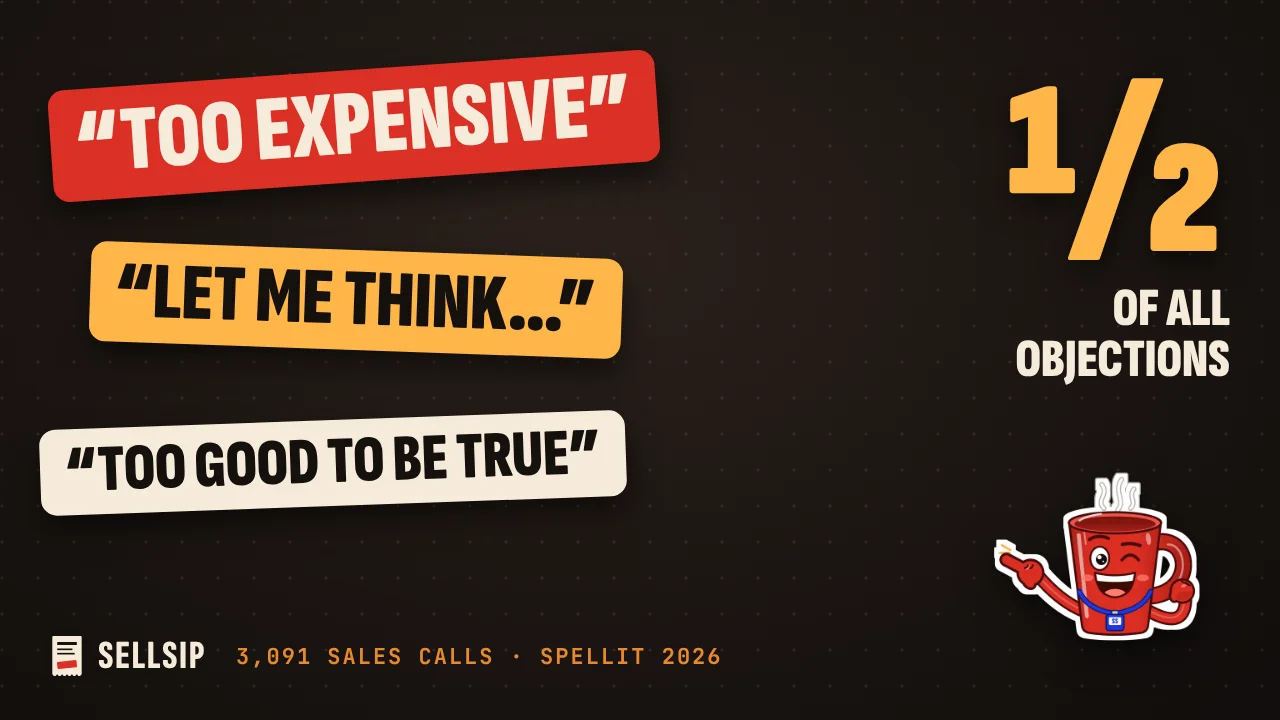
In Spellit's analysis of 3,091 sales calls (2026, vendor data), three objection families led: price and budget (19.9%), needing to think or "not now" (15.5%), and distrust, or "too good to be true" (13.6%). Together they made up about half of 4,050 tagged mentions. That shows what buyers say, not what loses deals, so treat it as a starting point to test.
Most reps prepare for objections the way they'd prepare for an exam: a long list, a line for each, and a hope that the right one comes back under pressure. It often doesn't. A shorter list you really know tends to hold up better.
This playbook looks at what one public count of objections found, and what you might try for each of the top three. Read it as evidence to test, not a script.
The count: the most common sales objections in 3,091 calls
Spellit, a company that sells sales call analysis, published the count on 4 Oct 2026. The article is by Aram Belinsky, its COO. It covers 3,091 sales calls from eight sales teams at five companies, over the 90 days to 4 Oct 2026. Across those calls, Spellit found 4,050 tagged objection mentions (Spellit, 2026).
Here are the top four families:
| Objection family | Share of mentions | Mentions |
|---|---|---|
| Price and budget | 19.9% | 805 |
| Needs to think / not now | 15.5% | 627 |
| Distrust / too good to be true | 13.6% | 552 |
| Not interested, status quo is fine | 5.9% | 237 |
Source: Spellit, Oct 2026, vendor data. Shares are of 4,050 tagged mentions.
Two things stand out. First, the top three together make up 49% of all mentions, 1,984 of 4,050, or about half (Spellit, 2026). Second, there's a big drop after third place: from 13.6% down to 5.9% for the fourth family, a gap of more than seven points (Spellit, 2026).
The tail is long, too. In this data, it took sixteen families to cover 90.6% of everything tagged (Spellit, 2026). So you won't get everything covered with three answers. But if you're short of practice time, these three look like the place to start.
"Too expensive": four meanings
"It's too expensive" sounds like one objection. Growth Engine Academy, a sales training academy in Cairo, suggests in a July 2026 guide that it can mean four quite different things. This is practitioner guidance, not research, and the translation from Arabic is ours.
| What it might mean | One question to ask | What to try |
|---|---|---|
| The budget really is lower | "Do you mean it's above the budget you set, or above another offer you're comparing it with?" | Look at a smaller starting scope, rather than cutting the price on the same scope |
| The value or return isn't clear yet | "What would this need to change for you to feel it's worth it?" | Go back to their problem and show the return in their terms |
| They're comparing with a cheaper offer that has different scope or terms | The same budget-or-offer question as above | Put scope and terms side by side so they're comparing like with like |
| They're testing how much room there is to negotiate | "If we found a way to make the numbers work, would you be ready to go ahead?" | Try holding the price first. If you do move, trade it for something |
The first question is Growth Engine Academy's (guide, 25 Jul 2026, our translation). The other two are our own wording, so they're worth testing in your market first.
The guide makes one more point that fits all four rows. A discount isn't the first answer. If you do give one, trade it for something in return: scope, contract term or payment timing. That way, the price still means something.
"Let me think about it"
This is the second-biggest family in Spellit's count, 15.5% of mentions (Spellit, 2026). It's also the one that's easiest to let slide, because it sounds polite and final.
Wider research suggests it deserves more of your attention. Matthew Dixon and Ted McKenna, co-authors of The JOLT Effect (Dixon also co-authored The Challenger Sale), studied more than 2.5 million recorded sales conversations. Writing in Harvard Business Review in June 2022, they found that between 40% and 60% of deals end up lost to customers who say they intend to buy but then don't act.
Why do buyers stall? On the JOLT Effect site (2024), Dixon and McKenna say that 56% of deals lost to no decision came from fear of failure, and 44% from a preference for the status quo. And one finding goes against instinct: pushing harder on the case against the status quo backfired 84% of the time (JOLT Effect, 2024).
So "think about it" may often be fear, not a lack of interest. Their method, JOLT, has four parts:
- Judge the indecision: is this buyer stuck, and on what?
- Offer a recommendation, rather than a menu of options.
- Limit the exploration, so they don't keep researching forever.
- Take risk off the table: trials, opt-outs, starting smaller, realistic expectations.
Growth Engine Academy (2026, our translation) suggests a simple first move. Respect the pause, then ask: "What's the main point you need to settle before you decide?" If there's nothing specific, agree a follow-up with a reason and a date. For example, you send a scope comparison today, and you talk on Tuesday after they've reviewed it. A "let me think" with a date and a reason tends to be easier to pick up again than one without.
"Sounds too good to be true"
Distrust makes up 13.6% of mentions in Spellit's count (Spellit, 2026). It can feel personal when it lands. But it's often just a buyer protecting themselves.
Growth Engine Academy's suggestion (2026, our translation) is to answer with the proof that fits the doubt, rather than with more enthusiasm. A rough guide:
- "Has this worked for anyone like us?" → a similar case, from a business that looks like theirs.
- "What happens if it doesn't work?" → clear guarantee terms, in writing.
- "Will this actually get done?" → implementation steps: who does what, and when.
Dixon and McKenna's last JOLT step fits here too (JOLT Effect, 2024). Realistic expectations can calm the doubt better than a bigger promise. Saying what your product won't do may make the rest easier to believe. That's worth testing.
The fine print
Spellit is open about the limits of its own data (Spellit, 2026):
- It covers five companies, which is exactly Spellit's own threshold for publishing (five companies and 100 calls).
- Each company wrote its own objection labels.
- One person grouped those labels by meaning.
- There's no win or loss data. So it shows what buyers say, not what loses deals.
- It's vendor data from a company that sells call analysis.
Belinsky puts the key limit plainly:
"the top three is a list of the three things buyers say, not the three things costing you deals"
Aram Belinsky, COO, Spellit, 2026
The type of call matters, too. MaxContact, a contact-centre software company, counted 803,000 objections in its outbound calling data (page updated 2026, vendor data). Its top four were No Immediate Need (151k), Not Interested (150k), Lack of Time (94k) and Too Expensive (69k). Different calls, different list on top.
On cold calls, Gong Labs and 30MPC's analysis of more than 300 million cold calls found that dismissive brush-offs made up 49.5% of objections (Gong, 2024, vendor data). So the brush-off tends to dominate on a cold call. Once a buyer is in a real sales conversation, price, hesitation and distrust seem to take over, at least in Spellit's data.
The Big Three drill
A short routine you could test for a week or two:
- Write one question for each of the three. Price, "think about it" and distrust. Just one question each, in your own words.
- For price, sort before you answer. Ask which of the four meanings it is before you say anything about the number.
- For "think about it", leave with a date. A reason, a day and a next step, or an honest close of the file.
- For distrust, match proof to doubt. Keep one similar case, your guarantee terms and your implementation steps ready to share.
- Practise out loud. Try the Objection Rapid-Fire game and say your three questions until they come out without thinking.
- Keep your own tally. Note which objections you actually hear. Your list may look different from Spellit's.
If most of your calls are cold calls, the brush-offs come first. See your first 60 seconds on a cold call. And to review the three questions before each call, add them to your pre-call routine.
Sources
All opened 3 Nov 2026. Vendor data is marked.
- Spellit (Aram Belinsky, COO), sales objections call data article, 4 Oct 2026. Vendor data. spellit.ai
- Matthew Dixon and Ted McKenna, "Stop Losing Sales to Customer Indecision", Harvard Business Review, 24 Jun 2022. Magazine article based on the authors' research. hbr.org
- Matthew Dixon and Ted McKenna, "What is the JOLT Effect?", JOLT Effect site, 2024. Practitioner guidance (the authors' summary of their research). jolteffect.com
- Growth Engine Academy, Arabic guide to handling customer objections, 25 Jul 2026. Practitioner guidance; quotes are our translation. growthengineacademy.com
- MaxContact, "What 800,000 Sales Calls Taught Us About Handling Objections", page updated 2026 (analysis date not stated). Vendor data. maxcontact.com
- Gong Labs × 30MPC (Armand Farrokh), "We found the top objections across 300M cold calls", 31 Jul 2024. Vendor data. gong.io
Read this as evidence to test, not a script. Results vary by market, language and buyer.
Questions people ask
What are the most common sales objections?
In Spellit's count of 3,091 sales calls (2026, vendor data), they were price and budget, needing to think or "not now", and distrust. Together they made up about half of tagged mentions. Other datasets, with other call types, show different lists.
Is price really the objection that loses most deals?
This data can't say. Spellit's count has no win or loss data (Spellit, 2026), so it shows what buyers say most often, not what costs deals.
Should I offer a discount when a buyer says it's too expensive?
Growth Engine Academy (2026) suggests a discount shouldn't be the first answer. Find out what "too expensive" means first. If you do give a discount, trade it for scope, term or payment timing.
Why do buyers say "let me think about it"?
There can be many reasons. Dixon and McKenna's research (JOLT Effect, 2024) links most no-decision losses to fear of failure, so lowering the risk may help more than pushing harder.