Playbooks · Cold calling · 9 min read
Your first 60 seconds on a cold call
You dial, they pick up, and you have a few seconds before they decide whether this is a conversation or an interruption. Here is what data from 300 million recorded cold calls, plus peer-reviewed research on real calls, suggests you say first, and what to say when the first "not interested" lands.
 By Altair · 2 Nov 2026
Quick answer · What should you say in the first 60 seconds of a cold call?
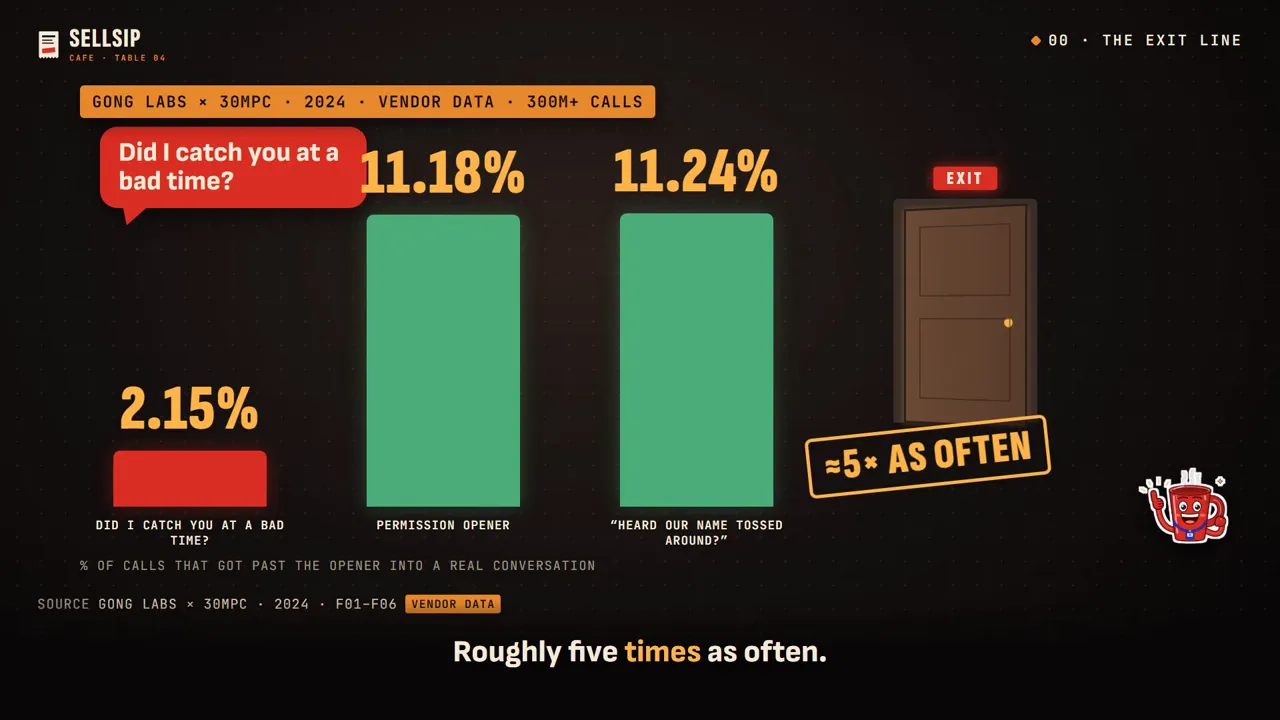
Four short lines tend to work: a specific reason you are calling this person, who you are in a few words, an honest "this is a cold call, can I take 30 seconds?", then the problem you solve in their words. In Gong's data from 300M+ calls, permission and context openers got past the opener about 11% of the time, against about 2% for "Did I catch you at a bad time?" (Gong Labs × 30MPC, 2024, vendor data). Test the wording in your own market.
Most of us were taught to be polite on the phone, so the first line that comes out is often a soft one: "Did I catch you at a bad time?" It feels respectful. The data suggests it is also one of the easiest ways to end the call before it starts.
This playbook walks through what the largest public cold-call dataset and a small peer-reviewed study suggest about the opening minute. Read it as evidence to test, not a script to follow word for word. Results vary by market, language and buyer.
Why the first seconds are so hard
Picture what the buyer hears: an unknown number in the middle of their day. Three questions run at once: who is this, why me, and how long will this take? If you don't answer them quickly, the buyer answers them for you, usually with a polite goodbye.
"Your cold call is an interruption to their day–you can't forget that."
Armand Farrokh, co-author of Cold Calling Sucks (And That's Why It Works), 30MPC newsletter, 26 Jan 2024
So the first job is not to pitch. It is to answer those three questions before the door closes.
The maths: why the opener carries so much weight
Gong, a company that sells call-recording software, analysed more than 300 million cold calls recorded on its platform, with the trainers at 30 Minutes to President's Club (30MPC). Their numbers for average and top-quartile reps:
| Step | Average rep | Top 25% of reps | Source |
|---|---|---|---|
| People reached per 100 dials | 5.4 | 13.3 | Gong Labs, 2024 (vendor data) |
| Meetings per 100 conversations | 4.6 | 16.7 | Gong Labs, 2024 (vendor data) |
| Dials per meeting | about 400 | about 45 | Our calculation from the two rows above |
Two cautions. These are Gong's customers, not a random sample, and Gong itself notes that top reps also pick better prospects, so list quality and skill are mixed together. The data does not prove the opener alone makes the difference. But it does show why a conversation lost in the first few seconds is expensive: at average rates, it takes hundreds of dials to replace.
And if most of your calls end without a conversation, that is the normal shape of the job, not a verdict on you. At 5.4 people reached per 100 dials, almost every dial ends that way.
Four common openers, ranked by the data
Gong and 30MPC ranked four openers by how often the rep got past the opener into a real conversation. That is not the same as booking a meeting.
| Opener | Got past the opener |
|---|---|
| "Did I catch you at a bad time?" | 2.15% |
| "How's your day going?" | 7.6% |
| Permission opener: admit it's a cold call, ask for 30 seconds | 11.18% |
| Context opener: a link to people like them, then "heard our name tossed around?" | 11.24% |
Source: Gong Labs, "The best and worst cold call openers", 24 Jul 2024 (vendor data, correlation, not a controlled test). Definition of success: 30MPC, Gong data. The top two are 0.06 points apart, so treat them as a tie.
Why "bad time" tends to struggle: it hands the buyer an easy yes, and the call ends. Gong's separate 2018 study of 90,380 calls found the same pattern with a different measure: calls that opened with it had a 0.9% success rate against a 1.5% baseline (Gong Labs, Chris Orlob, 2018, vendor data). Two vendor datasets six years apart both rank it lowest: a consistent pattern, though still vendor data.
A twist worth knowing: the 2018 study ranked "How are you?" well (3.4 times the baseline), and found that giving a clear reason for your call went with about 2.1 times the success rate. The 2018 study measured booked meetings, so the two years can't be compared directly. As Gong's Chris Orlob put it: "That's the nature of cold calling opening lines — they have a shelf life." Treat any ranking as a starting point to test.
Four lines for the first 60 seconds
Put the evidence together and a simple structure falls out. Each line answers one of the buyer's three questions.
- A reason you're calling them. One specific fact: a job post, a new office, a peer company you already work with. This answers "why me". Peer-reviewed research on real business calls found that features such as the "reason for calling" are consequential for how the call turns out (Humă & Stokoe, 2020, 150 calls).
- Who you are, in a few words. Name and company. It answers "who is this", and it is not the headline.
- Own the interruption and ask for 30 seconds. This answers "how long", and hands them control.
- The problem, in their words. After the opener, 30MPC's view of the Gong data found pitches built on a specific problem booked about 16 meetings per 100 conversations, against 12 for social proof and 5.5 for buzzwords and jargon (30MPC, Gong data, 2024, vendor data).
Here is how two of the trainers behind that data do it, in their own published examples:
"Look, I know you didn't expect me to call you this afternoon. Do you mind if I take one minute? I'll tell you why I called, and then you can tell me whether or not it's worth a chat."
Nick Cegelski, 30MPC newsletter, 2024
"Ha! Guess I'm not as popular as I thought. Well, the reason for my call is I work with a few other Sequoia portfolio companies, and typically…"
Armand Farrokh, when a prospect hadn't heard of his company, Gong Labs, 2024
Neither pitches the product in the first sentence. A fill-in version to adapt:
"Hi [name], I saw [specific fact]. It's [you] from [company]. I know this is a cold call: can I take 30 seconds to say why I called, and you tell me if it's worth a chat?"
The first "no": blocks and stalls
Even a good opener meets pushback. In Gong's data, five objections make up 74% of all cold-call objections. About half (49.5%) are dismissive, like "not interested", "send me some info" or "I'm in a meeting"; 42.6% are situational and 7.9% are about an existing solution (Gong Labs, 2024, vendor data; the authors add that these vary a lot from company to company). "Not interested" alone is 17% (30MPC, Gong data).
Farrokh's reading: "Objections are often a reaction to the interruption, not your pitch."
Academic research adds a useful lens. Bogdana Humă (Vrije Universiteit Amsterdam) and Elizabeth Stokoe (London School of Economics) studied 159 recorded business-to-business cold calls from four UK companies, made in 2014 to 2016. They describe "blocks through which prospects attempt to terminate the sale, and stalls through which they delay its progress" (Humă & Stokoe, 2023, peer-reviewed; open-access copy).
- A block, from a real call in the study (transcript simplified): "We're alright, thank you, we've got our own in-house marketing company."
- A stall: "Just email me the information." That is not a no. The door is still open.
What tends to help, in the Gong and 30MPC material: agree first, ask one question that gets them talking, then offer a small, low-risk next step, such as a short call at a set time rather than "I'll send something over". And give it a moment: in the same data, the median successful cold call ran about 4.8 minutes (30MPC, Gong data). That is a correlation, since calls with an interested buyer run longer, but folding at the first "not interested" makes a long call unlikely.
To practise these replies before you dial, play a 75-second round of Objection Rapid-Fire.
The fine print: who is telling you this
- Gong sells call-recording software, and the 300M+ calls come from its own customers. The patterns are correlations, not experiments.
- 30MPC sells a cold-calling book and course.
- Humă & Stokoe is peer-reviewed but small and British (159 calls, 2014 to 2016).
- SellSip has no sponsor and sells no call software.
The structure seems to travel well. The exact words need testing in your market, in your language, and within your country's calling rules.
Use it on your next call
- Drop "Did I catch you at a bad time?" for one week.
- Replace it with one specific reason you're calling them, and a 30-second ask.
- Keep it steady: Farrokh's advice for any opener is "Pick the one that sounds more like you, run it 50 times, and don't change it until you've got real data." (30MPC, 2024)
Before the first dial, run the free 60-second pre-call routine and checklist, then one round of Objection Rapid-Fire.
Sources
All opened 2 Nov 2026. Vendor data is marked.
- Gong Labs, Armand Farrokh, The best and worst cold call openers (backed by data from 300M calls), 24 Jul 2024. Vendor data.
- Gong Labs, Armand Farrokh, The hidden power of cold calling: Insights from 300M calls, 18 Jul 2024. Vendor data.
- Gong Labs, Armand Farrokh, We found the top objections across 300M cold calls, 31 Jul 2024. Vendor data.
- 30 Minutes to President's Club, How to Master Cold Calls: Data From 300M+ Calls (Gong data, 2024). Vendor data.
- 30MPC newsletter, Armand Farrokh, Two Effective Ways To Open Your Cold Calls, 26 Jan 2024.
- Gong Labs, Chris Orlob, Proven cold call opening lines that work, 19 Apr 2018 (90,380 calls). Vendor data.
- Humă, B. & Stokoe, E. (2023). Resistance in business-to-business "cold" sales calls. Journal of Language and Social Psychology 42(5-6), 630-652. doi.org/10.1177/0261927X231185520 (open access). Peer-reviewed.
- Humă, B. & Stokoe, E. (2020). The anatomy of first-time and subsequent business-to-business "cold" calls. Research on Language and Social Interaction 53(2). doi.org/10.1080/08351813.2020.1739432. Peer-reviewed (abstract used).
- "About 400 vs 45 dials per meeting" is our calculation: 1 ÷ (5.4% × 4.6%) and 1 ÷ (13.3% × 16.7%).
Questions people ask
What should you say in the first 60 seconds of a cold call?
Four short lines tend to work: a specific reason you are calling this person, who you are in a few words, an honest “this is a cold call, can I take 30 seconds?”, then the problem you solve in their words. In Gong's data from 300M+ calls, permission and context openers got past the opener about 11% of the time, against about 2% for “Did I catch you at a bad time?” (Gong Labs and 30MPC, 2024, vendor data). Test the wording in your own market.
Is “Did I catch you at a bad time?” a bad cold call opener?
In Gong's 2024 data it got past the opener on 2.15% of calls, the lowest of the four openers tested, against 11.18% for a permission opener and 11.24% for a context opener (vendor data, correlation). Gong's 2018 study of 90,380 calls also ranked it lowest. It tends to hand the buyer an easy exit, so it is worth testing a reason plus a 30-second ask instead.
How many cold calls does it take to book a meeting?
In Gong's 2024 data, an average rep reached 5.4 people per 100 dials and booked 4.6 meetings per 100 conversations, which works out to about 400 dials per meeting (our calculation). Top-quartile reps reached 13.3 and booked 16.7, about 45 dials per meeting. Top reps also tend to call better-fit prospects, so list quality matters as well as skill.
What do you say when a prospect says “not interested” on a cold call?
Agree first, ask one question that gets them talking, then offer a small, low-risk next step such as a short call at a set time. Research on real UK cold calls (Humă & Stokoe, 2023) separates blocks, which try to end the sale, from stalls like “just email me”, which only delay it, so a stall still leaves the door open.